Original visual and audio storytelling.
An original comic examining the Francoist ideology of “regeneración” during the Spanish Civil War (1936–1939) — the fascist rhetoric that cast political enemies as a disease to be eradicated. Centered on the August 1936 massacre at Badajoz, the work traces that violence back to its ideological roots: a coalition of monarchists, Falangists, and the Catholic Church that invoked racial and political “hygiene” to justify killing civilians on a massive scale, with critical military support from Germany, Italy, and Moroccan colonial troops. The visual style draws on Romantic painting’s treatment of the victim, the witness, and the perpetrator, pairing that art-historical lens with original research to stage the massacre and the ideology behind it.
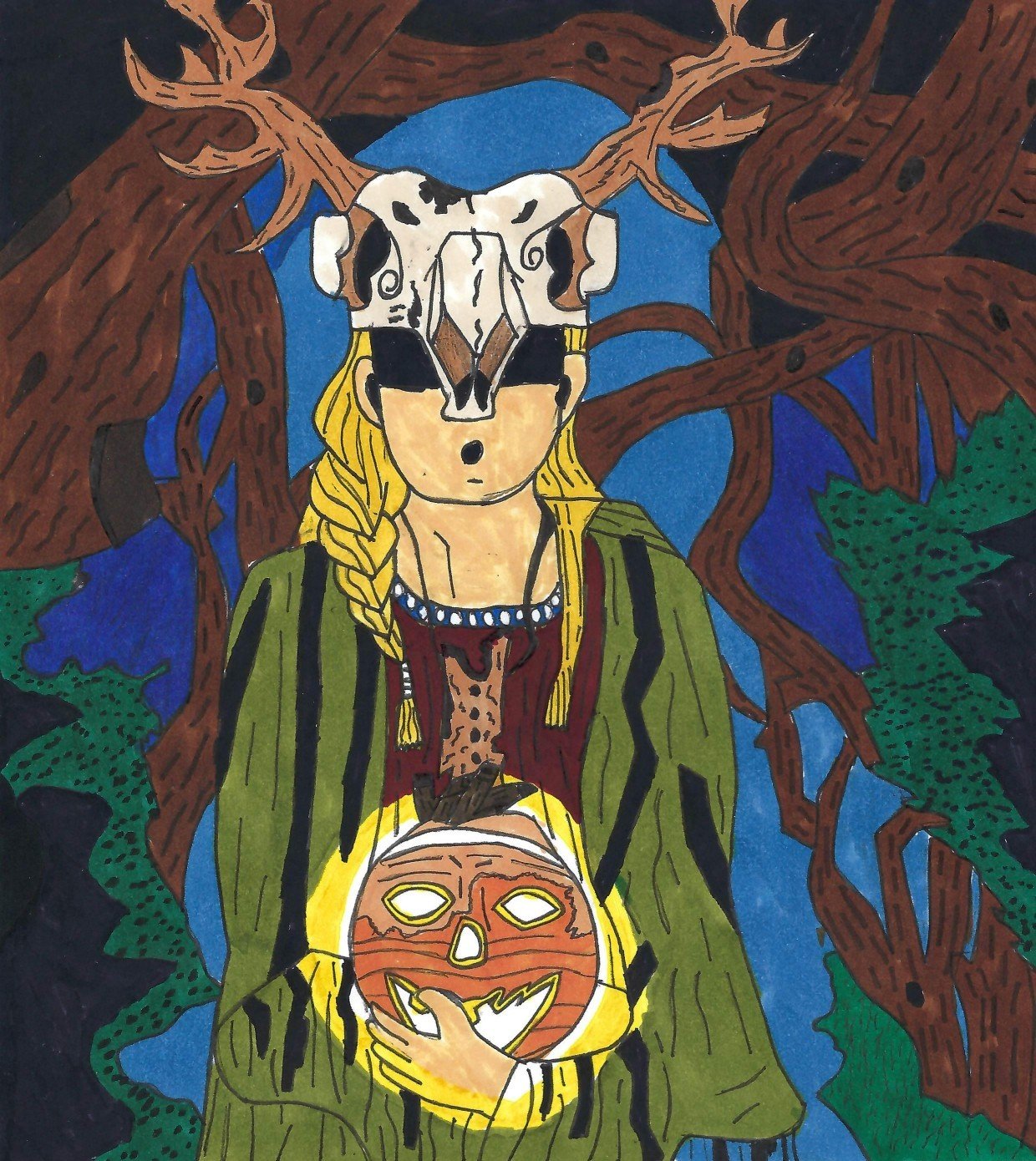
When the harvest fire burns most bright, the veil grows thin on Samhain night.
Leave them bread beside the light, and call your own by name tonight.
A girl clutched her bone whistle just a little tighter. She sat among many children like her, huddled around the great fire atop the hill. She could see the whole village from there. Earlier, villagers had been bustling about, gathering food and setting out bowls in preparation for the feast. Young women hanging apples on the trees stopped to watch the boys bobbing for them, praying for a lucky match. Mothers, shaking their heads, hung meat and scooped grain into the stores, while the fathers stood in a pasture with far too few animals. The elders knew this would be another hard winter: not all would survive. While some of the druids huddled around the hazelnut fire, straining to read the flames for an answer, others led the unlucky few to the slaughter. Indeed, Samhain was a crucible: the day everything changed, the day summer’s plenty gave way to the long, barren months. Amid the noise of preparation and the last of the summer merriment, if you listened closely enough, you could hear the screams of cattle and smell the blood of the sacrificed…
But that was earlier. Now everyone was gathered around the fire, listening to Grandmother recite the Samhain verse. The fire’s orange glow lit the deer skull atop her long white hair and high druid’s robes. Like many of the others similarly dressed, Grandmother looked as if she were a spirit herself.
But when the flames have died by dawn, the doors are shut…
And death reclaims them.
The girl shuddered. Looking to the east, she could see the ancient burial mound reigning over the cemetery. A thin, rolling fog crept from the abyss of its entrance into the surrounding moor and toward the village…
“The dead belong to God now. They are at peace.”
The crowd parted, revealing a lone table where a hooded man sat. Staring deep into a humble wooden bowl, he looked strange: his head was shaved in an odd crown above his simple brown robes, and a small wooden amulet hung at his neck. Still, odd as he was, the girl had always liked his kind brown eyes, lit by the small candle he carried. Grandmother turned toward the voice and gave him a scornful look.
“And who are you to speak, priest? Do you know what lurks in the dark? Why we wear their faces?”
Grandmother slowly began to approach the table.
“Would we sacrifice the last of our meager harvest…our everything…for nothing?”
She came closer. The priest held fast.
“Nay, you know naught of us, stranger…of this land…of what’s to come.”
And closer.
“Even if it took the whole store to catch a glimpse of the future…to protect us against the bitter year’s end…we would do what we must.”
Grandmother now loomed over the unmoving priest.
“So how would you prepare us, priest? With sermons and books?”
The girl had first seen the man in the spring, arriving from some unknown land in the east, proclaiming a strange new kingdom. He called himself Breanainn, but Grandmother and the others had little interest in learning his name. The girl often saw him in the commons, preaching to uninterested passers by.
“No one listens to you. Even the children mock you.”
It was true; many of her friends often went to watch his bizarre rituals and prayers and, on occasion, to steal his cakes.
“Speak.”
Brother Breanainn sat unfazed, running his finger around the rim of the bowl in front of him. He paused, then looked up, unflinchingly meeting Grandmother’s judgment.
“I do not question the fear in your hearts or the threats you face…but witchcraft and prophecy cannot bring back the dead or ease the wrath of God. Let them go…carry their memories with you and live on through prayer.”
Grandmother held his gaze.
“Prayer does not feed my people, priest, not in dark times.”
The girl heard whispers ripple through the crowd. “The oat fields rotted again; the stores won’t last through spring.” Another cried, “There will be famine! The Fair Folk must be appeased!” Underneath them all, a low murmur moved through the crowd. “Someone must be given…”
The priest stood, his brown eyes fixed on Grandmother’s.
“No one will be given. Not while there is light…while there is God in this world.”
Grandmother jabbed a long, thin finger into his chest.
“And when the stores run empty, will your god feed them?”
He held his ground.
“I bring the bread of life…”
Then he turned to face the crowd.
“And all are welcome at my table.”
At the edge of the gathering, just beyond the glow of the firelight, the girl gazed at another lone table. Its occupant was absent: an empty chair before an empty bowl. Grandmother, not noticing the girl approach, felt a light tug on her robe. She looked down to see the girl pointing toward the empty seat. Her stony face cracked.
It was as if the girl could still see her brother in that chair, playing his whistle while she laughed beside him. Grandmother looked away, and Breanainn lowered his head. The tension broke.
The crowd began to disperse as the flames turned to coals. The girl clutched her bone whistle a little tighter to her chest. Grandmother took her hand.
“I wish he were here too.”
And the two walked home as the sun went down.
The Choice
As the last light of dusk faded, the girl watched her grandmother place a small bowl of oats at the foot of the door. Grandmother pointed toward the cemetery and said, “For those who walk tonight. If we feed them, they’ll pass us by.” The girl nodded and looked at the bowl, then pulled a small drawstring sack from her robe. She opened it: empty. She looked toward the cemetery, then back at Grandmother, who understood. “You want to feed him too…then go to him, child, but mind yourself.”
Grandmother knelt, looking into her eyes.
“The spirits take children…”
And with that warning, Grandmother removed her cloak and tied it around the girl. She took a small piece of charcoal from her robe and darkened the girl’s face, then removed the skull from her own head and placed it atop the girl’s. Grandmother stepped back to admire her work and said approvingly, “So the dead shall not know you.”
Grandmother handed her the carved turnip from the doorstep and sent her off into the gathering dark.
As the girl approached the outskirts of the darkening village, she saw Brother Breanainn kneeling outside his hut. The stranger was always busy; bits of scribbled parchment covered in magic symbols lay strewn beside the farming tools, and stacks of covered baskets nearly blocked the entrance, proof of all the baking he’d been doing lately. Now he was perfectly still, eyes closed, silently mouthing one of his chants. Just as she drew past, a voice called out.
“Little Monster?”
She turned toward it to see his kind brown eyes. Brother Breanainn approached the girl and stooped beside her. “The hour is so late for dress-up; why do you wander?”
Following her gaze, he looked out toward the cemetery.
“Ah, I see. You wish to bid him goodnight.”
Standing, he held out his hands, gesturing for the turnip. When she handed it over, he placed his candle inside, making a small but bright lantern.
“Take my light; let it guide your way. I’ll pray for you while it burns.”
With a bow, she turned to set off.
“And child…”
She looked back.
“Noli timere,” he whispered with a smile.
Out in the fields, just past the village, the girl began digging for any oats the harvest had left behind. She remembered when she and her brother used to pick oats together; the horses grazed in the moorland as they laughed and played in the lush green fields. Now the soil was gray and sandy, and shriveled black seeds were all the land could give. At last, she found a small patch of good oats. As she gathered them into her sack, she noticed a dark horse’s silhouette in the distance. She fumbled with the drawstring, clutching her sack as she hurried away
When the moon finally rose, it lit the humble grave the girl knelt beside. She didn’t know Grandmother’s sacred rituals or the magic words of Brother Breanainn, but in her own way, she mouthed something to the grave and began to untie the sack. As she reached in for a handful of oats, she heard a silky voice behind her.
“Why does a child walk among the dead?”
She whipped around to see darkness and a pair of burning red eyes. A dark silhouette rose from among the graves to reveal a tall black horse.
“Alone among the graves, on the night the spirits take what wanders in the dark.”
The girl shielded the grave, tense and glaring at the figure.
“You think I took him…your brother.”
The girl bared her teeth, motionless.
“It’s true. I’ve been here before…and I knew his face.”
It came closer, towering over the girl.
“And now I know yours…”
Knuckles white on the sack, she clutched the whistle at her chest with her other hand, trembling. With a labored breath, she let go of the whistle and reached into the bag with shaking hands. She placed a small handful of oats before the horse, hearing Grandmother’s words: Feed them, and they’ll pass us by. Her brother used to feed the horses in the moorland.
The horse cocked its head, as if remembering something. Slowly, it began to eat, lowering its neck to reveal its gaunt, hollow ribs.
Finished, it met her eyes.
“You give, even when you have so little. Just as he did.”
A tear ran down her face as she lowered her head and set the sack on the grave. She began to walk away.
“But a gift is owed a gift.”
She stopped and turned around.
“Though he is gone, he lies not in that ground. Bring him what you carry, and he’ll come home with you.”
Her eyes widened. She took the sack back from the grave and held it tight.
“I am the Puca, and I offer you a choice. You may go, but know he will remain lost.”
Then, to her surprise, it lowered its head and knelt before her.
“Or ride with me beneath the open mound, and you will find what was lost…before the fire dies and the dead claim you.”
The girl paused, looking back at the village lights and then toward the eerie mound at the center of the cemetery. The fog had grown thicker and was creeping toward her. She had made up her mind.
The girl mounted the horse and gazed at her brother’s grave one last time…
Before plunging down…down…down…into the earth…
And into an Otherworld.